Commercial Septic Services in Orlando That Keep Your Doors Open
A septic backup on a Friday night can close a restaurant for the whole weekend. Our commercial septic services in Orlando are built to stop that from happening. We pump, inspect, repair and maintain business systems across Orange, Seminole, Osceola and Lake County. We cover scheduled pumping, lift stations, aerobic units, grease interceptors and after hours calls. You get written reports for your records and your permit file.
Who Do Our Commercial Septic Services Serve in Greater Orlando?
We serve 9 main property types across Greater Orlando. They include restaurants, hotels, plazas, offices, churches, schools, warehouses, mobile home parks and RV parks. The state's sizing rule gives each one its own daily flow. So a church and a diner with the same tank need very different care.
Rule 62-6.008 sets these design flows in Table I.
| Property type | Florida design flow (Table I) |
|---|---|
| Restaurant | 40 gallons a day per seat, or 60 if open over 16 hours |
| Hotel or motel | 100 gallons a day per room |
| Office | 15 gallons a day per employee per shift, or per 100 sq ft |
| Church | 3 gallons a day per seat, plus 5 per meal served |
| Day school | 10 gallons a day per student |
| Shopping center | 0.1 gallons a day per sq ft |
| Warehouse | 15 per employee per shift, plus 100 per loading bay |
| Mobile home park | 225 to 300 gallons a day per space |
| RV park | 50 or 75 gallons a day per space |
We also work with HOAs, assisted living homes and property managers who oversee several sites. A busy diner sends far more water and grease through its tank than a quiet office. Your service plan should match that load.
Different loads call for different services.
Which Septic Services Does an Orlando Business Need?
Most businesses need 5 core services. These are scheduled pumping, lift station and pump care, aerobic unit maintenance, inspections, and repair or replacement. Kitchens add grease interceptor service. Every plan should also cover after hours emergency calls. Start with the parts your system has, then set a schedule.
What Is the Best Septic Tank Pumping for Commercial Use?
The best septic tank pumping for commercial use empties every compartment, not just the first one. The crew should measure sludge and scum, check the baffles and clean the outlet filter. You should get a written report with the gallons removed. If a crew pumps only part of the tank, the state requires written notice to the owner.
What Do Lift Stations and Dosing Pumps Need?
Commercial dosed systems over 500 gallons a day must run 2 pumps that take turns. If one pump fails, the other keeps your business running. Each visit should test both pumps, every float and the alarm panel.
How Do Aerobic Units Work for Businesses?
An aerobic treatment unit adds air so bacteria can treat waste further. The state requires a maintenance contract for every unit. Under the state rule, units serving businesses get 4 inspections a year.
What Does Commercial Septic Installation Involve?
Installation follows 4 main steps. A qualified evaluator checks the site and soil. You apply for a permit through the county health office. The crew installs an FDEP approved tank and drain field. Then an inspector signs off before you use it. Sites near Wekiwa Spring and Rock Springs may need a nutrient reducing system.
When Does a Business Need an Inspection or Camera Check?
Book one before you buy or lease a property. Book one after repeat backups, too. And book one before an expansion adds seats, rooms or staff, because more people means more flow.
Is Grease Interceptor Waste Handled Like Septage?
No. Florida treats grease interceptor waste as food establishment sludge. It is handled and disposed of separately from regular septage. Ask your hauler to show you where each load goes.
These services all sit inside a set of state rules.
Commercial Septic Florida Rules: What Does the State Require?
Florida sets 5 key rules for business systems. Onsite systems cap commercial flow at 5,000 gallons a day. Businesses with commercial waste need an annual operating permit. Table I sizes flow by seat, room or worker. Grease interceptors start at 750 gallons. Commercial aerobic units get 4 inspections a year.
The Florida Department of Environmental Protection has run the onsite sewage program since July 1, 2021. County health offices still handle much of the local permit and inspection work. Your business has to keep up with both.
When Is a Business Too Big for a Septic System?
Statute 381.0065 caps onsite systems at 5,000 gallons a day of commercial flow. Above that, the state moves you into a different permit program. Here is a quick example. A 100 seat restaurant open 16 hours or less uses 4,000 gallons a day, which fits. The same restaurant open around the clock uses 6,000 gallons, which does not.
Does Your Business Need an Annual Operating Permit?
Yes, if your business makes commercial sewage waste or sits in an industrial zone. The permit lasts 1 year, and the state inspects the system at least once a year. A 2026 law, House Bill 1417, kept that yearly term for businesses. Waste stronger than normal household sewage can bring extra testing.
How Does Florida Size a Commercial System?
Start from the Table I flow, then apply 2 adjustments. Kitchen flow counts as 66% of a food business's total. High volume sites near interstates use 3 times the normal table flow. That matters for busy stops along Interstate 4. Table II then sets the tank size. For example, 501 to 600 gallons a day needs a 1,350 gallon tank.
What Are Florida's Grease Interceptor Minimums?
A grease interceptor must hold at least 750 gallons. Anything larger than 1,250 gallons needs multiple chambers or units in series. Restaurants size theirs using a formula based on seats, hours open and a load factor. Your installer runs that math for your permit.
What Do Florida Pump and Aerobic Unit Rules Require?
Systems dosing over 500 gallons a day need 2 alternating pumps. Every aerobic unit needs a maintenance contract. The first runs at least 2 years, then it renews for life. The rule sets 4 inspections a year for business units. A 2026 law changed some inspection rules, so confirm your schedule with your county office.
Rules set the minimum. Your schedule sets the real protection.
How Often Should a Business Pump Its Septic Tank?
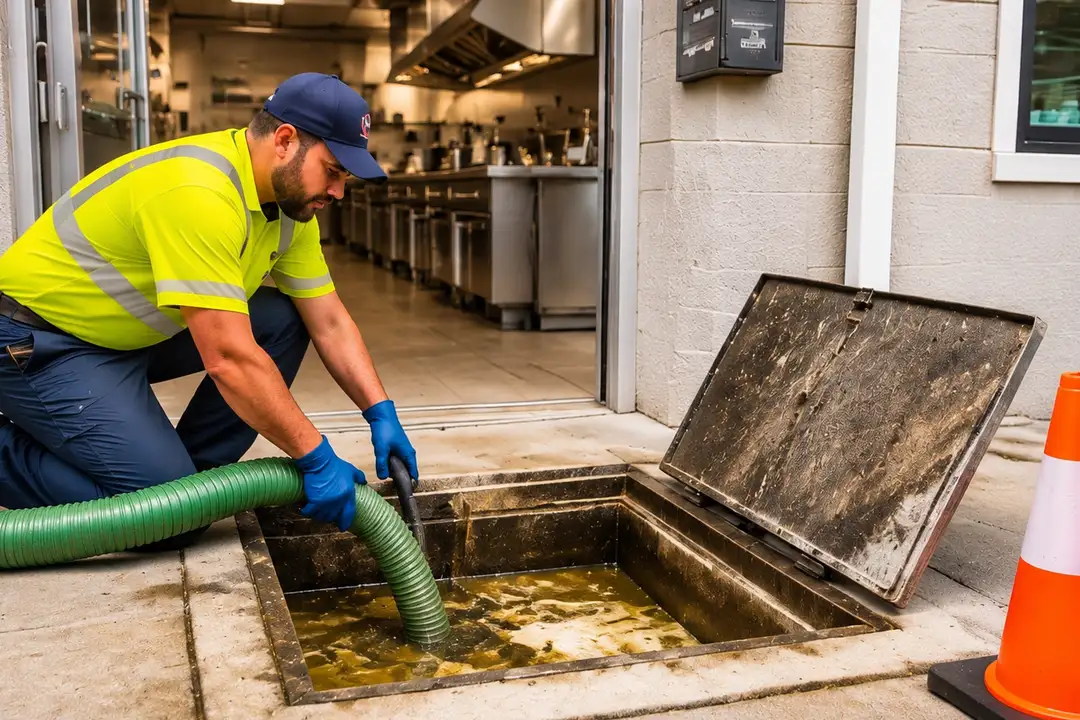
Every 1 to 5 years is the usual range, but use matters most. The EPA puts household tanks at 3 to 5 years. Busy restaurants with a garbage disposal often pump every year. Florida sets no fixed interval for businesses. So measure sludge and scum on a schedule, then pump before solids reach the outlet.
| Property type | Suggested starting point |
|---|---|
| Restaurant | Check every quarter, pump at least yearly with a disposal |
| Hotel | Check twice a year |
| School | Pump during summer break |
| Church | Check yearly and after large events |
| Office | Check yearly |
| Mobile home or RV park | Check every quarter, rotate pumping across tanks |
| Aerobic unit at a business | 4 inspections a year under state rule |
A contract turns that schedule into a routine.
What Should a Septic Maintenance Contract Include?
A good contract covers 6 things. It sets visit dates, lists every tank, pump and alarm, and states response times. It also includes written reports, pump out records and permit renewal reminders. Florida requires a contract for every aerobic unit, starting at 2 years.
Many owners ask why they have to pay for a contract at all. The answer is simple. Some county health offices will not issue an aerobic unit permit without a current maintenance agreement. Approved maintenance companies must also respond to emergencies within 36 hours. A contract buys you a place at the front of the line.
What Septic Records Should Your Business Keep?
Keep 5 records on file: the operating permit, the maintenance agreement and inspection reports. Add pump out receipts with gallons, plus any notice of a partial pump out. State rules make haulers keep their logs for 5 years, so match that. Good records help at permit renewal, at sale and in lease disputes.
Good records also make scheduling easier.
Can You Schedule Septic Work Without Closing Your Business?
Yes, with 2 steps. First, book routine pumping before you open or after you close. Second, prep the site by clearing truck access and marking every lid. State rules say pump trucks must hold at least 1,500 gallons. A large tank may take more than one load. Schools can use summer break.
If your tank sits under a parking lot, ask about traffic rated lids. They let cars park on top and still give the crew quick access. Plan which restrooms stay open during the visit, and tell staff ahead of time. Set calendar reminders before your permit renewal date, too.
Planning prevents most emergencies, but not all.
What Should You Do in a Septic Emergency at Work?
3 steps come first. Stop water use where you can and close the affected restrooms. Call your septic company and note any alarm lights. If sewage comes from a county sewer line in Orange County, call Orange County Utilities at 407.836.2777 or 311.
Storms bring the worst calls. After Hurricane Milton in 2024, Seminole County said its lift stations were overwhelmed. Florida's health department also warns that a dosing pump will not run without electricity. If your system relies on a pump, ask about a backup power plan before hurricane season.
Some owners solve repeat emergencies by leaving septic behind.
Should Your Business Switch From Septic to Sewer?
95 properties in Pine Hills recently made the switch. Orange County connected 65 businesses and 30 homes along Pine Hills Road. The project wrapped up on June 10, 2026, at no cost to the owners. It sits inside the Wekiwa Spring and Rock Springs protection area. If sewer reaches your lot, ask your utility about timelines and grants.
The Pine Hills work ran north of West Colonial Drive and west of Barnett Park. Once a business connects to sewer, the old tank must be properly abandoned under a state permit. That means pumping it, breaking it open and filling it with clean sand. Your septic company can handle that final step.
Switch or stay, cost often drives the choice.
How Much Do Commercial Septic Services in Orlando Cost?
Expect 4 cost layers. Pumping runs about $0.30 to $0.70 per gallon nationally, so tank size drives the bill. Seminole County's health office charges $225 a year for a commercial operating permit. Aerobic unit contracts start near $900 at one Florida company. Emergency calls often cost 50% to 100% more.
| Item | Typical figure | Where it comes from |
|---|---|---|
| Pumping | $0.30 to $0.70 per gallon | National cost guide |
| Commercial operating permit | $225 a year | Seminole County health office, 2025 to 2026 |
| Aerobic unit operating permit | $150 every 2 years | Seminole County health office, 2025 to 2026 |
| Aerobic unit maintenance contract | From about $900 | One Florida septic company |
| Emergency or after hours visit | Often 50% to 100% more | Florida septic directory |
Orange County fees were not available, so ask your county office. Each quote also depends on gallons, access, disposal fees and timing.
Who pays that bill is often a lease question.
Who Pays for Septic Care in a Commercial Lease?
3 lease clauses usually decide who pays: maintenance, repairs and utilities. Triple net leases often shift upkeep to the tenant. Florida's operating permit names the party responsible for operation and maintenance. Make sure that name matches your lease. This is general guidance, not legal advice.
One Central Florida restaurant owner described three years of grease and septic backups in a rented space. The fight was over who should fix it. Clear lease terms prevent that. Also note that operating permits do not transfer. When a new tenant moves in under the same owner, Florida asks for a business survey form. Talk to a Florida attorney about any dispute.
Whoever pays should hire with care.
How Do You Choose a Company for Commercial Septic Services?
Put 5 questions to every company first. Is it a Florida registered septic tank contractor? Does it hold a current DEP septage service permit? Is it an approved maintenance entity for aerobic units, if you need one? Will it give written pump out reports? Can it show commercial jobs near Orlando?
Florida's owner exemption covers only a person working on their own home. A business must hire a registered contractor and a permitted pumper. Ask for references from a property like yours, such as a restaurant, a church or a plaza.
Local know how matters, because Orlando's loads are unusual.
Which Orlando Areas and Industries Do We Serve?
76.7 million visitors came to Orlando in 2025, a record, according to Visit Orlando. That traffic loads hotels, restaurants and attractions across the region. We serve businesses in Orange, Seminole, Osceola and Lake County. Florida uses 3 times the normal design flow for busy sites near interstates.
Restaurants and hotels along International Drive face heavy kitchen and restroom loads all year. Strip plazas in older areas like Pine Hills often still run on septic. We bring commercial septic service to Winter Park, Kissimmee and the towns in between. Tell us your address and property type, and we will build a plan around your flow.
Questions Orlando Business Owners Ask
Still have a question? Call and talk to a real person.
Call (321) 872-9877 →How Do You Get a Permit for Commercial Septic Installation in Florida?
Apply through your county health office. Include the application, a site plan, a site evaluation from a qualified professional and the fee. Larger or high strength systems may also need an engineer’s design.
What Is an Onsite Sewage Treatment and Disposal System?
It is Florida’s legal term for a septic system. It means a tank plus a drain field, sometimes with pumps or an aerobic unit. Businesses use the same parts on a bigger scale.
What Will Fail a Septic Inspection at a Business?
Common problems include effluent pooling over the drain field, broken baffles and a clogged outlet filter. Dead alarms, a pump that will not cycle and missing records also cause trouble. Fix these before your annual visit.
How Big a Septic Tank Does a 50 Seat Restaurant Need?
Fifty seats at 40 gallons each comes to 2,000 gallons a day, if you open 16 hours or less. Table II then sets the tank size. You also need a separate grease interceptor of at least 750 gallons.
Do You Offer Commercial Septic Service After Hours?
Yes. We book early morning, late night and weekend visits. Your kitchens and restrooms stay open during business hours. Ask about scheduled off hours pumping when you call.
Does a New Tenant Need a New Operating Permit?
Operating permits do not transfer to a new owner. If the owner stays the same but the tenant changes, Florida asks for a business survey. Your septic company or county office can tell you which form applies.
What Is the New Septic Law in Florida for Businesses?
House Bill 1417 took effect on July 1, 2026. Commercial operating permits still renew every year. Separate rules near Wekiwa Spring and Rock Springs can require nitrogen reducing upgrades when a system is repaired.
Can a Business Owner Pump or Repair Its Own Septic System?
No. Florida’s owner exemption only covers a person working on their own single family home. Businesses must hire a registered contractor, and only a permitted hauler may pump and transport the waste.
Do Restaurants on Septic Need a Grease Interceptor?
Yes, in most cases. Grease from a kitchen can clog the tank and seal the drain field. Florida requires interceptors of at least 750 gallons for food businesses on septic.
Book Service for Your Business
Keep your doors open and your records clean. Call (321) 872-9877 to set up commercial septic services for your property. We serve Orange, Seminole, Osceola and Lake County with written reports and flexible hours.