
New Drain Field Installation in Orlando, FL
You bought a lot or started a build. Now the county wants a soil report before anything else. That report shapes your whole system. We handle drain field installation in Orlando for new homes and new systems. We work across Orange, Seminole, Osceola and Lake County. On this page, you will learn the 2 inputs that size your field. You will also see the 24 inch rule that decides between a trench and a mound. Then we cover permits. Already have a field that floods or smells? See our page on how to fix a field that is failing.
Start with the rules every new field must meet.
What Are the Florida Septic Drain Field Requirements?
Florida sets 3 core rules. The bottom of the field must sit at least 24 inches above the wettest season water table. Good soil must extend 42 inches below the field. And no pavement or vehicles may cover it. FDEP writes these rules in Chapter 62-6, and your county health office checks them.
If you see references to Chapter 64E-6 online, those rules are out of date. The septic program moved to the Florida Department of Environmental Protection in 2021. Its rules now sit in Chapter 62-6. Rule 62-6.006 also says fill must raise a building site above the 2 year flood level. Rule 62-6.014 names the trench as the preferred layout.
The field also has to sit the right distance from wells, water and buildings.
How Far Must a New Field Be From Wells, Pools and Water?
| Feature | Minimum distance |
|---|---|
| Private drinking water well | 75 feet |
| Public well, 2,000 gallons a day or less | 100 feet |
| Public well, over 2,000 gallons a day | 200 feet |
| Non drinking water well | 50 feet |
| Lakes, streams and other surface water | 75 feet |
| Swales, retention areas and dry ditches | 15 feet |
| Storm sewer or drinking water line | 10 feet |
| Foundations, property lines and pool walls | 5 feet |
A field can never sit under a building, deck, patio or sidewalk. So yes, plan your pool and shed around the field, not the other way around.
How Much Open Space Does Florida Require Around the Field?
Florida asks for an unobstructed area next to the field. It must be at least 1.5 times the size of the absorption area. For example, a 200 square foot field needs 300 square feet of open ground beside it. This space comes in addition to the setbacks above.
To size the field, someone first has to dig and read your soil.
How Does a Site Evaluation Test Your Soil?
A site evaluation uses at least 2 soil borings, each 6 feet deep or to refusal. One sits at each end of the planned field. The evaluator logs soil texture, today's water level and the wettest season level. Florida uses this report, not a classic perc test, to size your field.
Only certain people may do this work. They include Florida licensed engineers with soils training, master septic tank contractors, certified soil scientists and state staff. The evaluation must be done within 180 days before you apply. To find the wet season level, the evaluator reads soil color and mottling. USDA soil maps and plants on site help too. Seminole County's health office charges $125 per soil profile for 2025 to 2026.
Buying a home that already has a system? Book a full septic inspection instead.
What the borings find depends on where your lot sits.
What Do Orlando Area Soils Mean for a New Field?
Central Florida soils fall into two broad groups. Flatwoods sands, such as Smyrna and Immokalee, drain poorly. USDA surveys show water within 18 inches of the surface. It stays 1 to 4 months in most years. Ridge sands, such as Tavares and Candler, drain well. Tavares keeps water 42 to 72 inches down, and Candler keeps it below 80 inches.
Tavares soil takes its name from its reference site in Lake County, on SR 448 near Lake Jem Road. On a flatwoods lot, an in ground trench usually cannot meet the 24 inch rule. On ridge sand, a standard trench often works.
Soil type also sets how big the field must be.
How Large Does a Septic Drainfield Need to Be?
A 3 bedroom home on fine sand needs at least 375 square feet of trench bottom. Florida sizes fields in 2 steps. First, it rates your home's daily flow at 300 gallons for 3 bedrooms. Then it divides that flow by the soil's loading rate, which is 0.80 for fine sand.
Florida drainfield size requirements come from two tables in Rule 62-6.008. Table I rates homes at 100, 200, 300 and 400 gallons a day for 1 to 4 bedrooms. Each extra bedroom, or each extra 750 square feet of floor area, adds 60 gallons a day. The state uses whichever count gives the larger flow.
Table III sets the loading rate by soil. Watch for one trap. Fine sand and loamy fine sand sound alike, but loamy fine sand needs a field about 23% larger. The tightest soil within 24 inches below the field bottom controls the size.
| 3 bedroom home, 300 gallons a day | Fine sand | Loamy fine sand | Clay loam |
|---|---|---|---|
| Trench loading rate | 0.80 | 0.65 | 0.35 |
| Minimum trench bottom | 375 sq ft | about 462 sq ft | about 857 sq ft |
| Bed loading rate | 0.60 | 0.35 | 0.20 |
| Minimum bed bottom | 500 sq ft | about 857 sq ft | 1,500 sq ft, the bed limit |
| Trench length at 36 inches wide | 125 ft | about 154 ft | about 286 ft |
| Lines needed (100 ft max each) | 2 | 2 | 3 |
| Open area, 1.5 times the trench | about 563 sq ft | about 693 sq ft | about 1,286 sq ft |
Our arithmetic from Rule 62-6.008 Tables I and III and Rule 62-6.014. Your evaluator's numbers govern.
A 4 bedroom home on fine sand rises to 400 gallons a day. That needs 500 square feet of trench or about 667 square feet of bed.
How Big Is a Leach Field for a 1,000 Gallon Septic Tank?
Florida does not size the field from the tank. Both come from the same daily flow, so your bedroom count and soil decide the field. If you need septic tank and drainfield installation together, the tank follows its own table. Our tank page lists the minimum tank sizes by bedroom.
Once you know the area, you choose how to lay it out.
Which Drain Field Type Fits Your Lot?
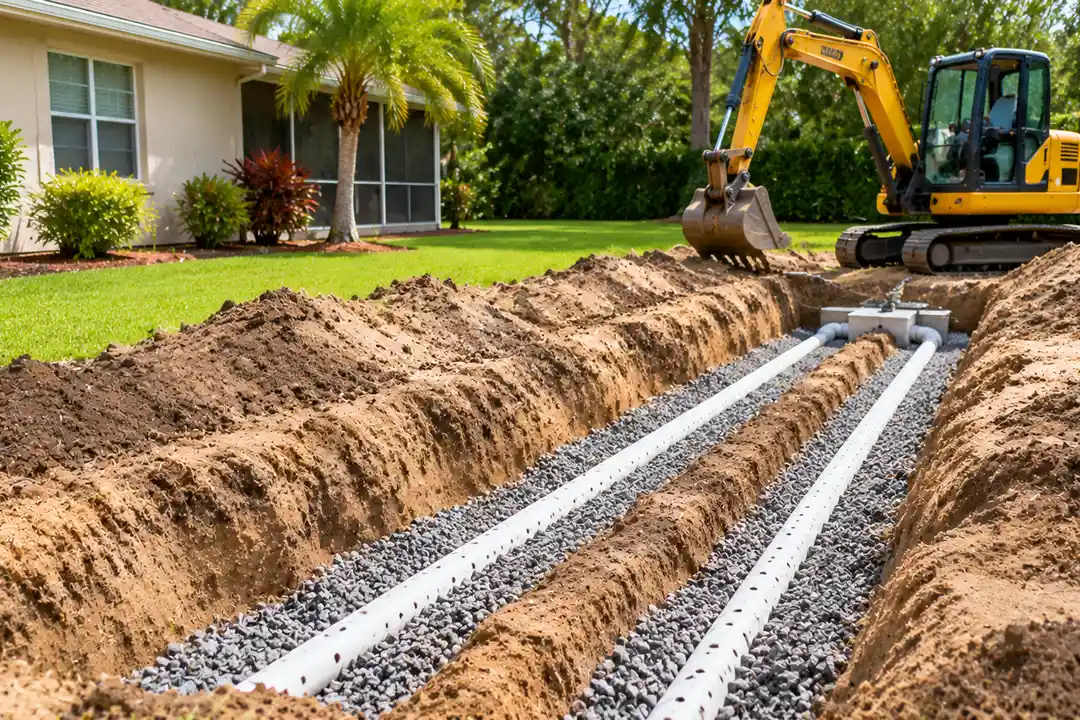
Most Orlando fields use 1 of 3 materials. Gravel trenches use 12 inches of rock under a fabric barrier. Plastic chambers, such as Infiltrator Quick4, leave an open space under a dome. Gravelless bundles, such as EZflow, wrap pipe in foam aggregate. Florida credits each product by a set area, not a discount.
FDEP keeps a list of approved drainfield products, last reviewed October 13, 2026. A Quick4 EQ24 chamber counts as 8 square feet. A Quick4 EQ36 counts as 12 square feet, or 3 square feet per foot. That matches a 36 inch gravel trench exactly. So chambers do not shrink a Florida field. Take the 375 square foot example. You would need 47 EQ24 chambers, 32 EQ36 chambers or about 94 feet of EZflow 1203H.
| Type | How it works | Best fit | Watch for |
|---|---|---|---|
| Gravel trench | Perforated pipe in 12 inches of approved rock under fabric | Ridge sands with deep water | Heavy rock deliveries |
| Chamber | Open bottom plastic domes, no rock | Tight access where trucks cannot reach | Cut chambers are not allowed |
| Gravelless bundle | Pipe wrapped in light synthetic aggregate | Jobs that need light material | Follow the maker's manual on FDEP's list |
| Absorption bed | One wide dig with lines 36 inches apart | Narrow lots | Lower loading rates mean more area |
| Filled or mound | Field raised in clean fill above native soil | High water table lots | Fill volume, slopes and often a pump |
| Low pressure dosed | Pump sends timed doses through small lines | Large fields and some mounds | Pump tank, alarm and power |
| Drip dispersal | Shallow tubing after an aerobic or performance based unit | Special sites | Engineer design and a maintenance contract |
Trench or Bed: Which Layout Does Florida Prefer?
Trenches. Rule 62-6.014 calls the trench the preferred method and caps trench width at 36 inches. Beds are allowed up to 1,500 square feet, with 10 feet between beds. Beds use lower loading rates, so they need more area. In the fine sand example, that means 500 square feet instead of 375.
Layout is the easy choice. Height is the hard one on a wet lot.
When Does a New Field Need Fill or a Mound?
You need fill or a mound when your soil cannot give 24 inches of dry ground below the field. A filled system raises part of the trench walls above native soil. A mound raises the entire field bottom. Both use clean sand, sloped sides and a soil cap, and many need a pump.
Rule 62-6.009 sets the shape. A mound needs a 4 foot flat shoulder between the edge of the fill and the nearest trench. Mounds up to 36 inches tall need side slopes of at least 2 to 1. Taller mounds need 3 to 1. A cap of at least 6 inches of soil covers the top. The field bottom can sit no more than 30 inches below finished grade.
Crushed rock and poor soil cannot be used as fill. If the mound uses moderately limited soil, it needs low pressure dosing. Any retaining wall requires a Florida licensed engineer. Is a mound more expensive? Yes, because of the fill, slopes and pumps. See the cost section below.
Raised fields often bring in a pump, and big fields always do.
When Is Low Pressure Dosing Required?
Florida requires low pressure dosing when your field tops 1,000 square feet. A pump tank sends timed doses through small pressure lines. You can split the area into 2 fields instead. Fields over 2,000 square feet need at least 2 pumps. Smaller fields may use simple lift dosing.
Dosing spreads water evenly so no single spot floods. In sandy soil, a system can dose up to 6 times a day. The pump tank needs an alarm you can see and hear. That way you know at once if a pump fails.
On some lots, the state now asks for more than a bigger field.
What Is the New Septic Law in Florida for New Systems?
Since July 1, 2023, House Bill 1379 changed new installs near springs and in BMAP areas. A new system on a lot of 1 acre or less must reduce nitrogen when sewer is not available. Options include in ground biofilters, nitrogen reducing aerobic units and performance based systems. Biofilters target at least 65% nitrogen removal.
The Wekiwa and Rock Springs Priority Focus Area covers part of northwest Orange County. Orange County says new homes there on 1 acre or less must join central sewer when it is available. Seminole County offers an online address lookup for springs rules. It adds a $50 review fee in those areas. In ground biofilters also need a notice recorded with the property. That matters if you plan to sell the land.
Whatever system you need, it starts with a permit.
Do You Need a Permit to Install a Drain Field in Florida?
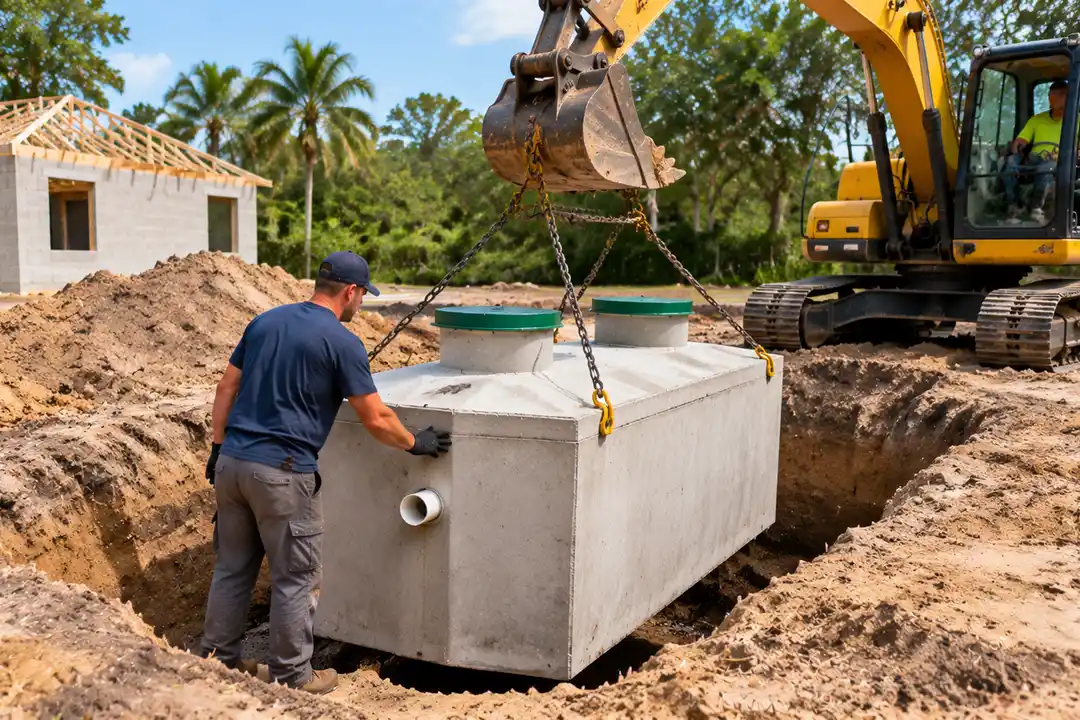
Yes. Florida law says no one may build a septic system without a permit. You apply at your county health office with Form DEP 4015. Add a site plan, a floor plan and the soil report. Seminole charges $425 for a new system permit. An inspector must check the work in person before it is covered.
The site plan must be drawn to scale and show wells, drainage and nearby water. The floor plan shows your bedrooms and square footage. An application stays valid for 1 year. Since July 1, 2022, private inspection providers may also inspect some work.
Can you skip the contractor?
Can You Build Your Own Septic Field?
Only in one case. Florida Statute 381.0065 lets an owner who personally works on their own home skip contractor registration. That home must be a single family house the owner lives in. Every permit, soil evaluation and inspection still applies. Some websites claim Florida bans homeowner installs, but the statute says otherwise. Mistakes in grade, fill or dosing will still fail inspection.
Here is how a permitted install runs.
How Does Orlando Drain Field Installation Work, Step by Step?
A new field follows 6 steps. A qualified evaluator bores and logs your soil. A designer sizes the field from your flow and soil. You file the county permit. The crew digs, levels and builds the field. An inspector checks it before cover. Then the crew backfills, grades and lays sod.
Precision matters during the build. The trench bottom must be level, or slope no more than 1 inch per 10 feet. No part of the field can sit within 18 inches of the tank. After the soil settles, at least 6 inches of cover must remain. One Orlando installer quotes 1 to 3 days of field work and 1 to 4 weeks for permits.
Each of those choices moves the price.
How Much Does a New Drain Field Cost in Florida?
Most standard Orlando fields cost $5,000 to $12,000, according to Angi. Raised and dosed fields cost more because of fill, pumps and power. Nitrogen reducing systems in springs areas can reach $35,000. Plan on permit and soil test fees too.
| System | Typical range | Source |
|---|---|---|
| Standard field | $5,000 to $12,000 | Angi, Orlando |
| Chamber field | $4,000 to $13,000 | One Orlando installer |
| Mound | $8,000 to $15,000 | One Orlando installer |
| Low pressure dosed | $8,000 to $15,000 | Florida cost guide, indicative |
| Nitrogen reducing, Wekiwa area | $10,000 to $35,000 | Angi, Orlando |
Fill is a big part of a raised field. One Florida homeowner's video put septic sand at $4,240 of a $9,162 job. Your price depends on the water table, soil rate, fill volume, yard access and sod.
Protect that money in the first year.
How Do You Protect a New Field?
Protect a new field with 4 rules. Keep cars, trucks and pavement off it. Plant only grass on top. Send roof gutters away from it. Keep the open area clear of sheds and pools. Florida bans concrete, asphalt and vehicle traffic over the field and its open space.
The first few months matter most. The soil is still settling, and new sod needs time to root. Mark the field edges so mowers, delivery trucks and pool crews know where not to drive.
The right installer makes all of this easier.
How Do You Find Leach Field Installation Near You?
Ask 5 questions first. Is the installer registered with the state as a septic contractor? Who does the soil evaluation? Will it file the county permit? Which FDEP listed product will it use, and why? Does the written quote include fill, sod and dosing? A good installer answers all 5 without stalling.
Field Installation Questions
Still have a question? Call and talk to a real person.
Call (321) 872-9877 →How Long Does a New Drainfield Last in Florida?
Often 20 to 30 years, according to one Orlando installer. Pumping habits and a high water table can change that. If yours fails early, see our repair page.
What Is the Florida Septic Code?
It is Chapter 62-6 of the Florida Administrative Code, written by FDEP. It replaced the older Chapter 64E-6 rules.
How Deep Is a New Field in Florida?
The field bottom can sit no more than 30 inches below finished grade. At least 6 inches of cover must remain after the soil settles.
Do Chambers Make the Field Smaller?
No. Florida gives each approved product a fixed area credit. A chamber field covers about the same ground as a gravel trench of the same width.
Can the Field Go Under a Driveway or Patio?
No. Florida bans pavement, decks, patios and vehicle traffic over the field and its open area. Plan driveways around it from the start.
Does a Bigger House Need a Bigger Field?
Yes. Every added bedroom or 750 square feet of floor space raises design flow by 60 gallons a day. More flow means more field.
Can Laundry Water Go to Its Own Field?
Yes. Florida allows a separate laundry drainfield. When you add one, the main field can be up to 25% smaller.
Who Can Do the Soil Evaluation?
Florida licensed engineers with soils training, master septic tank contractors, certified soil scientists and state staff can do it. Ask your installer who will handle yours.
Are Drainfield and Leach Field Different Terms for One Part?
No difference. Drainfield, leach field and absorption field all describe the soil area that treats your tank’s water.
Book Your Soil Evaluation
Book the soil evaluation before you close on a lot or pull a building permit. Call (321) 872-9877 to plan drain field installation in Orlando. We serve Orange, Seminole, Osceola and Lake County.