
Lift Station and Septic Pump Repair in Orlando, FL
A red light is flashing on the box by your house, and it will not stop buzzing. That alarm means water is rising in your pump tank. We handle lift station repair for homes, HOAs and businesses across Orange, Seminole, Osceola and Lake County. We fix the Orlando septic pump, floats, check valves, alarms and control panels. Below you will find the 5 usual causes, real repair costs, and when to call.
First, here is what that box in your yard does.
What Is a Lift Station, and Is It the Same as a Septic Tank?
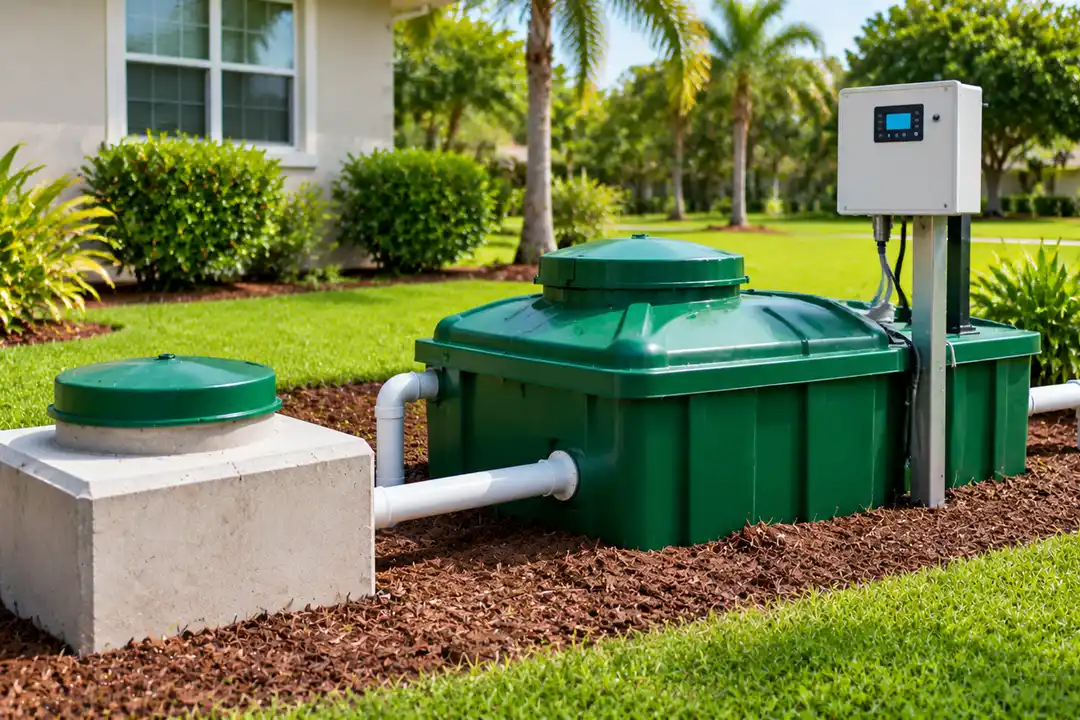
A lift station is a pump basin that moves wastewater uphill when gravity cannot. It is not a septic tank. At most homes it is a second tank after the septic tank. It holds a pump, float switches and a high water alarm that warns you before a backup.
Florida rules call this a pump tank or dosing tank. People also call it a septic pump station or a pump up septic system. They all mean the same thing at a house. Liquid leaves the septic tank, fills the pump tank, and the pump pushes it out to your drain field.
A neighborhood or commercial station is bigger. It collects sewage from many buildings and pushes it into the public sewer.
What Are the Parts of a Lift Station?
| Part | What it does |
|---|---|
| Basin or wet well | Holds the wastewater until the pump runs |
| Pump | Pushes the water out. Homes use an effluent, grinder or ejector pump |
| Float switches | Turn the pump on and off, and trigger the alarm |
| Check valve | Stops pumped water from flowing back |
| Control panel and alarm | Powers the pump and warns you of high water |
| Force main | The pressure pipe that carries water away |
| Guide rails | Let crews lift heavy pumps out at commercial sites |
So why do so many homes here need one?
Why Does Your Orlando Home Need a Septic Pump?
Many homes need a pump because the drain field sits higher than the tank. Florida's state soil, Myakka fine sand, covers more than 1.5 million acres. Its water table can rise within 10 inches of the surface for 1 to 5 months a year. Where water sits that high, drain fields are often raised.
A raised or mound drain field needs help. Florida Rule 62-6.014 covers lift dosing, where a pump lifts effluent up to the field. Some systems use pressure dosing, which spreads the water evenly through small pipes. Central Florida lift stations of this kind are common on lots with low ground or a high water table.
A septic pump in Orlando also shows up on newer nitrogen reducing systems. Orange County's Septic Upgrade Incentive Program pays up to $10,000 toward these upgrades, with priority near Wekiwa Springs.
When that pump has a problem, the alarm tells you first.
Why Is Your Home Septic Alarm Going Off?
Most septic alarms sound because water in the pump tank rose above the alarm float. There are 5 usual causes. Think failed pump, stuck float, tripped breaker, bad check valve, or rain and groundwater getting in. A running toilet or a heavy laundry day can trigger it too.
Your alarm is not an extra. Florida Rule 62-6.013(9) requires an audio and visual high water alarm in a spot you can see. Many homes use a simple float alarm, such as the SJE Rhombus Tank Alert. When it sounds, the system is asking for help before sewage backs up.
What Should You Do When the Alarm Goes Off?
- Press the silence button. The red light stays on, but the noise stops.
- Check the breaker. Find the septic or pump breaker in your electrical panel. Reset it once if it tripped.
- Look outside. Check for standing water or a wet spot near the tanks.
- Cut water use. Skip laundry and the dishwasher. Keep showers short.
- Give it time. Let the pump run a couple of cycles. One Florida company puts that at 10 to 15 hours.
If the red light stays on, book septic lift station repair near you. Do not open the pump tank or the control panel yourself. Sewer gas and live wiring make both dangerous.
How Long Can You Use Water With the Alarm On?
One Florida septic company says alarms are set for about 24 to 48 hours of normal use. That is a rule of thumb, not a promise. A home with one pump may have little room left. Florida asks installers to set pump levels low to save reserve space. Use as little water as you can until a tech checks it.
The next question is whether the pump itself is broken.
Can Septic Pumps Be Repaired, or Do They Need Replacing?
Often they can be repaired. Many alarms trace back to a float, a breaker or a check valve. National guides put septic pump repair at $250 to $400. A burned motor or worn impeller usually means a new pump at $500 to $3,000 in Orlando.
A good tech tests before quoting. We check the power at the panel and measure the pump's amperage draw. We test each float and look at the check valve. That tells us if the problem is a $100 part or the whole pump.
Age matters too. If a pump is near the end of its life, repair money is often wasted. Septic lift station pump repair makes sense on a younger pump with one bad part. Orlando septic pump replacement makes more sense on an old pump that keeps failing.
What Is the Most Common Cause of Pump Failure?
Wipes, grease and rags cause the most trouble. They wrap around the impeller and jam the floats. Even "flushable" wipes do not break down fast enough. Power surges are next, and they can burn out a motor. Florida humidity also corrodes wiring and float cords over time. Most lift station pump repair calls trace back to one of these three.
How Long Does a Septic Pump Last?
Effluent pumps usually last about 7 to 15 years. Grinder pump estimates vary more, from 5 to 10 years in one guide to 25 years in another. Sources do not agree. What you send down the drain, how often the pump runs and your power quality make the biggest difference.
So can you swap it yourself?
Can You Replace a Septic Pump Yourself?
You can, but 3 hazards make it risky: sewer gas, a confined tank and live wiring. Florida also requires pumps certified for effluent or built to SSPMA standards. Pressure systems must match a pump curve. A wrong pump can flood your drain field or burn out in months.
Here is how a pro handles an Orlando septic tank pump replacement:
- Shut off power at the breaker.
- Pump down the tank so the old pump is safe to reach.
- Pull the pump and check the float heights.
- Install a matching pump and test the check valve.
- Run a full cycle and confirm the alarm works.
Florida law also bars anyone from working as a septic tank contractor without state registration under Section 489.552.
Do You Need a Permit to Replace the Pump in Florida?
It depends on the job. Florida requires a construction permit for all septic repairs. Its rule also says that replacing parts "with like kind" mechanical or electrical parts is not a repair. A same size pump swap may fall under that. A new pump type, a new pump tank or work on a failing system likely needs a permit. Ask your contractor to confirm with the FDEP Onsite Sewage Program before work starts.
Bigger properties face bigger stations and stricter rules.
How Are Commercial and HOA Sewer Lift Stations Different?
Commercial stations move far more flow, so many run 2 pumps that take turns. Florida requires 2 alternating pumps on commercial septic systems over 500 gallons a day. Sewer pump stations also need emergency power under Rule 62-604.400. A generator or portable pump hookup can meet it.
These stations serve apartments, HOAs, plazas, restaurants, mobile home parks, schools and churches. Pumps sit on guide rails so crews can lift them out. Many sites use alarms that text or call a manager.
A commercial lift station service company should handle the whole station. That means pumps, floats, panels, valves, wet well cleaning and backup power. Sewer lift station repair at these sites has to happen fast. Dozens of units can depend on one basin. Many owners sign up for pump station maintenance services to avoid surprise failures.
What Does Florida Rule 62-604 Require at Pump Stations?
Rule 62-604.400 sets 4 key standards for pump stations:
Emergency pumping
must be available for all pump stations.
An in place generator
is needed where other stations feed in, or pipes are 12 inches or wider.
Lightning and surge protection
must be installed.
Full operation
must continue during a 25 year flood.
Other stations can meet the power rule with 2 independent power sources, a generator hookup or portable pumps. Ask your engineer or utility if your private station falls under this rule.
Rules set the floor. Maintenance keeps you above it.
How Often Should a Lift Station Be Serviced?
Plan on 1 to 2 checkups a year for a home pump tank. Commercial and HOA stations need service every 3 to 6 months. Busy sites may need monthly checks of floats, pump amps and alarms. Most stations also need a wet well cleanout once or twice a year.
| Property | Service visits | Wet well cleanout |
|---|---|---|
| Home pump tank | 1 to 2 times a year | When grease or sludge builds up |
| Commercial or HOA station | Every 3 to 6 months, monthly if busy | 1 to 2 times a year |
Sewer lift station maintenance pays for itself. A float caught early costs a fraction of a burned pump.
What Should a Lift Station Maintenance Contract Include?
Good lift station maintenance services cover every part on a set schedule:
| Part | What gets checked |
|---|---|
| Wet well | Cracks, grease buildup, debris |
| Pumps | Amperage draw, impeller wear, noise |
| Floats | Clean, free moving, set at the right heights |
| Check valves and vents | No leaks, no backflow |
| Panel and alarm | Lights, horn, wiring, corrosion |
| Backup power | Generator test or hookup check |
| Records | Written report after each visit |
When waste leaves the site, ask for a manifest showing where it went. Searching for a septic lift station inspection near you or sewage lift station maintenance near you? Ask if the visit includes every line above. For the tank and drain field, pair it with a full septic inspection.
Next, here is what all of this costs.
How Much Does Lift Station Repair Cost in Orlando?
Most Orlando homeowners pay $500 to $3,000 to replace a septic lift pump. One Apopka plumber quotes $500 to $1,200, and one Orlando septic firm quotes $1,500 to $3,000. Commercial pumps run $3,000 to $8,000 or more. A full system can pass $10,000.
| Job | Typical cost (national estimates) |
|---|---|
| Float switch | $100 to $300 |
| Alarm install | $250 to $400 |
| Control panel | $300 to $500 |
| Pump repair | $250 to $400 |
| Effluent pump, installed | $400 to $900 |
For septic pump replacement, Orlando prices depend on pump type, tank depth and wiring. Night and weekend visits cost more. You get a written quote before we start.
Storms are when these costs spike.
What Happens If a Lift Station Fails in a Storm or Power Outage?
Without power, a lift pump stops and the tank keeps filling. After Hurricane Irma, Florida's health department told septic owners to stop using water until power came back. During Hurricane Ian, 5 Orange County lift stations ran on generators. Two went underwater at Lake Sue and Lake Pearl.
The Lake Sue station sits off Fawsett Road in Winter Park. High lake levels caused backups in nearby neighborhoods. Hurricane Milton hit hard too. On October 10, 2024, Duke Energy had 82,309 Orange County customers without power. OUC had 83,869 customers affected, and Seminole County said its stations were overwhelmed.
Follow these steps when the power goes out:
- Stop using water until power returns.
- Keep the tank lids closed if your yard floods.
- Watch the alarm when power comes back on.
- Book a check if the alarm stays lit.
Commercial owners should test the generator or hookup before hurricane season starts. Lift station repairs pile up after every big storm, so early service saves you a long wait. If the tank overfilled during the outage, you may also need septic tank pumping.
Who Do You Call When a Public Sewer Backs Up?
Is the backup coming from a county sewer? Call Orange County Utilities Emergency Dispatch at 407-836-2777, or dial 311. If the station belongs to you or your HOA, book lift station service near you instead.
Where Can You Find Lift Station Repair Near You in Greater Orlando?
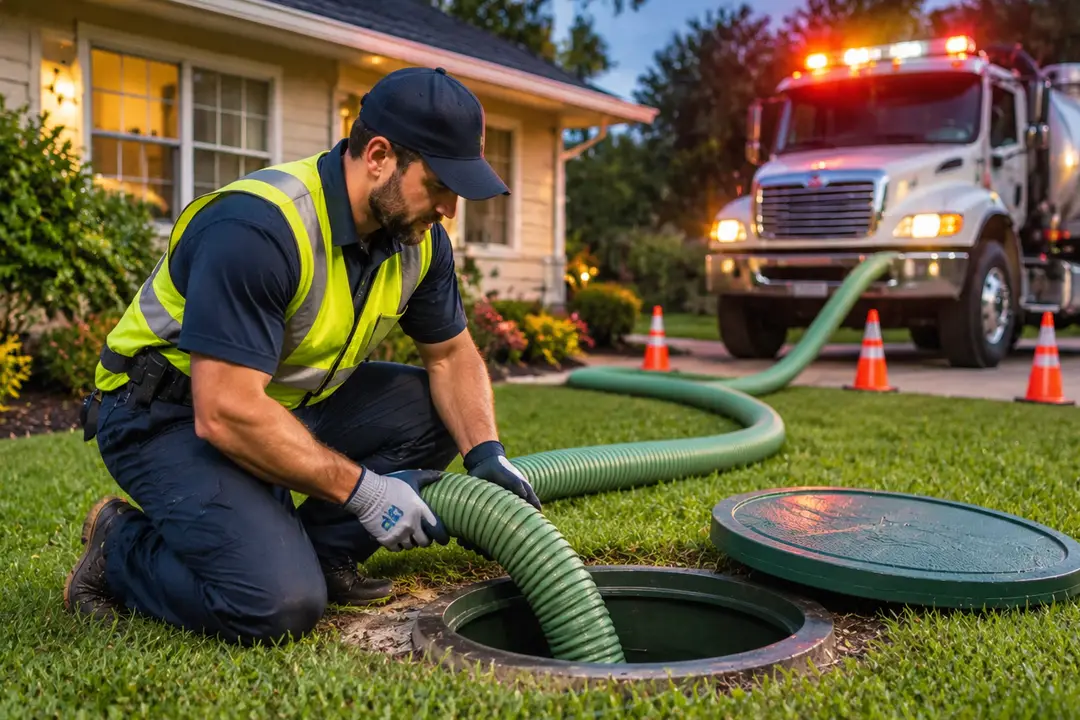
We cover 4 counties: Orange, Seminole, Osceola and Lake. Call with your address, and we will confirm a visit window.
| Orange | Seminole | Osceola | Lake |
|---|---|---|---|
| Orlando, Winter Park, Apopka, Ocoee | Sanford, Lake Mary, Oviedo | Kissimmee, St. Cloud, Celebration | Clermont, Leesburg |
Our crews handle lift station repairs near you for single family homes, rentals and HOAs. We also take sewer lift station repair calls near you for plazas, restaurants and apartments.
The last step is picking who comes out.
How Do You Choose the Right Company in Orlando?
Check 4 things before you book. Look up a Florida septic or plumbing license. Ask for proof of insurance. Get a written quote that names the pump brand and model. After the job, ask for a service record.
Ask a few questions on the phone too. Do you carry common pumps on the truck? Will you test the floats and alarm before you leave? Do you offer a warranty on parts and labor? A lift station service you can trust answers all of these without hedging.
Get Your System Working Again
Do not wait for a backup. Call (321) 872-9877 for lift station repair across Orange, Seminole, Osceola and Lake County. We fix the problem, test the system and leave you a written record.
Pump, Alarm and Station Questions
Still have a question? Call and talk to a real person.
Call (321) 872-9877 →How Much Does It Cost to Replace a Lift Station?
A full home system with a new basin, piping and wiring can pass $10,000, per one Orlando firm. Most jobs only need a new pump, float or panel. A tech can tell you which one after a test.
How Much Does a Lift Station Pump Cost?
The pump unit alone often costs a few hundred dollars for an effluent pump. Grinder pumps cost more. Labor and wiring add to the total. Ask for a written quote on a lift station pump near you.
How Long Does a Pump Station Last?
Pumps usually last about 7 to 15 years. The basin and pipes can last much longer. No source gives one number for a whole station, so an inspection is the best way to judge yours.
How Do You Reset a Septic Alarm?
Press the silence button, then check the pump breaker. Cut your water use and let the pump run. Most alarms clear once the water level drops. If the red light stays on, call for service.
Can You Silence the Alarm and Wait for Business Hours?
You can silence the sound, but the high water stays. Cut water use right away. If the light is still on after a few hours, book service that same day.
Does Your Home Have a Lift Station?
Look for an alarm box on an outside wall or post. Then look for a second lid past the septic tank. Not sure if there is a lift station near you? A tech can find it in minutes.
Who Owns Neighborhood Lift Stations?
Many lift stations near you belong to a utility, such as Orange County Utilities. Stations inside plazas, apartments or some HOAs belong to the property owner. Check your HOA documents to be sure.
What Is the Worst Thing for Your Pump?
Wipes, grease and rags. They jam floats and wrap around the impeller. Keep them in the trash, and the pump will last longer.
What Is a Lift Station Mechanic?
This tech tests and repairs pumps, floats, panels and valves. In Florida, commercial work is often done by firms with plumbing or underground utility licenses.
Call for Septic Service Today
Septic service across Orange, Seminole, Osceola and Lake County. You get a written price before we start.