
Septic Tank Installation and Replacement in Orlando, FL
A new septic system in Orlando usually takes 1 to 3 days of work on your property. Permits and the site evaluation come first and can add a few weeks. We offer septic tank installation in Orlando, FL for new homes and replacements. We also remove old tanks. We handle the paperwork, the digging and the final inspection. You get a written quote before any work starts.
Licensed Septic Installers Orlando Homeowners Can Count On
Your new system will serve your home for decades. The crew you hire decides how well it works from day one. As a septic installation company, here is what we bring to every job.
Permits handled
We file the application, site plan and site evaluation with the county health department.
A real soil check
We test the ground before we choose a tank or design the drain field.
Approved tanks only
Florida requires every septic tank to carry FDEP approval before it can be sold or installed.
A written quote
You see the full price for the tank, drain field, permits and labor up front.
Clean finish
We backfill, grade and leave the yard ready for sod.
Good septic installers do more than set a tank in a hole. They make sure the system fits your soil, your lot and your family size. That is what keeps you from paying twice.
How Does a New Septic System Installation Work?
A new septic system installation follows 8 steps, from soil test to final inspection. Here is what our septic tank installation service looks like on your property.
- Site evaluation. We bore into the soil to check its type and the seasonal high water table.
- Design and permit. We size the tank and drain field, then file the permit with the county health department.
- Mark the layout. We stake the tank, pipes and drain field and call to locate buried utility lines.
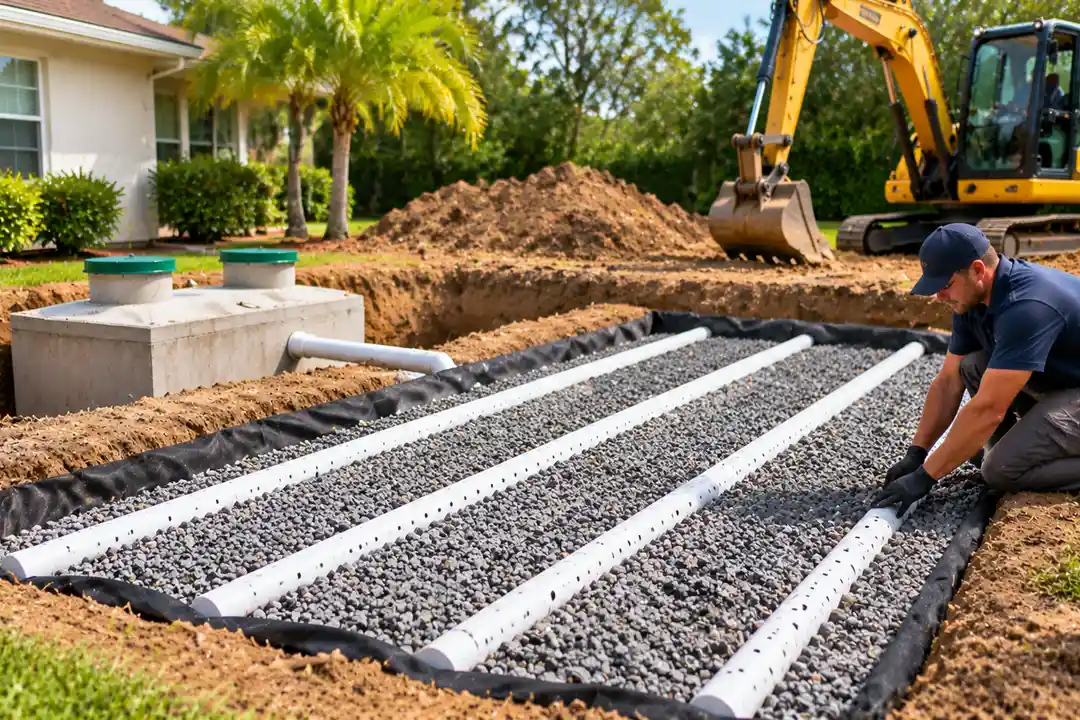
- Dig. An excavator opens the hole for the tank and the trenches or bed for the drain field.
- Set the tank. We lower the tank in, level it and seal every joint.
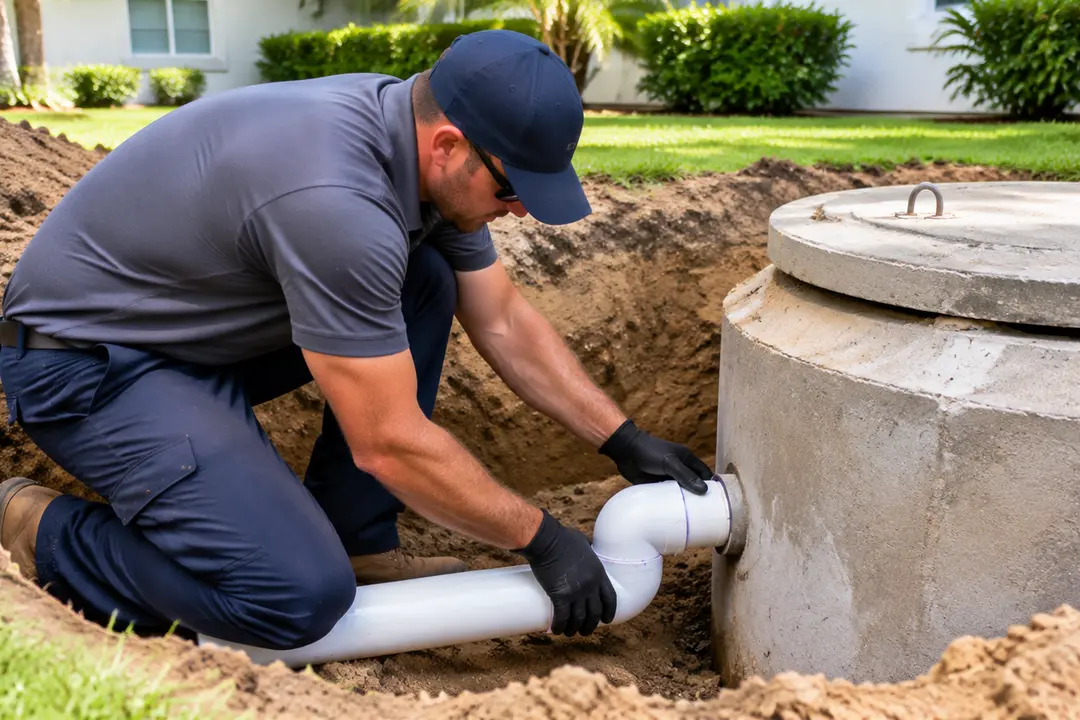
- Connect the pipes. We tie in the line from your house and the line out to the drain field.
- Build the drain field. We lay the pipe or chambers, add fill if needed and cover the field.
- Inspect and backfill. The health department checks the work before we cover it and grade the yard.
Septic installation in Central Florida often needs extra fill. When the water table sits high, the drain field gets built up. That keeps it far enough above groundwater.
What Does a Site Evaluation Check?
The site evaluation is the most important step. A qualified evaluator digs soil borings where the drain field will go. They record the soil type, how fast it drains and the depth of the seasonal high water table. In much of Central Florida, that water table sits close to the surface in summer. The results set your drain field size and how much fill you need. They also show if a standard system will work.
How Long Does a Septic Installation Take?
Most jobs take 1 to 3 days on site. The full process, including soil testing, permits and inspections, often runs a few weeks. Rain, fill delivery and inspection schedules can add time. We give you a timeline when we quote the job.
Do You Need a Permit to Install a Septic Tank in Florida?
Yes. Florida law says no one may build, repair, change or abandon a system without a permit. In Orange, Seminole, Osceola and Lake County, the local Florida Department of Health office issues these permits.
Here is what the application includes:
Form DEP4015, page 1
The permit application.
Form DEP4015, page 2
A site plan showing the house, tank, drain field, wells and property lines.
A floor plan
This helps set the size of the system.
A site evaluation (DH4015)
A qualified professional checks the soil and water table.
The permit fee
The county sets the total based on the system type.
After the work is done, the system needs a final inspection and approval before you use it. We schedule that for you.
Can You Install Your Own Septic System in Florida?
Yes, but only in one case. Florida lets a property owner work on the system for their own single family home that they live in. You skip contractor registration, but you still need every permit and inspection. Most owners hire a pro, because a mistake can fail inspection or flood the drain field.
What Are the Requirements for a Septic System in Florida?
Florida sets clear rules for size, depth and distance. Your system must meet all of them to pass inspection.
| Requirement | Florida rule |
|---|---|
| Minimum tank size | 900 gallons for up to 3 bedrooms (Rule 62-6.008) |
| 4 bedrooms | 1,050 gallons |
| 5 bedrooms | 1,200 gallons |
| 6 bedrooms | 1,350 gallons |
| Water table distance | At least 24 inches below the drain field (Rule 62-6.006) |
| Distance from a private well | At least 75 feet (Rule 62-6.005) |
| Distance from lakes and streams | At least 75 feet |
| Tank design | Two compartments, plus an outlet filter or deflector (Rule 62-6.013) |
The bedroom count is a starting point. A large home can need a bigger tank, because the rules also look at square footage.
How Many Bedrooms Will a 1,500 Gallon Septic Tank Support?
A 1,500 gallon tank goes well past Florida's minimum for a typical home. A 3 bedroom house only needs 900 gallons, and a 6 bedroom house needs 1,350. A bigger tank gives you more room between pump outs. Your permit sets the exact size for your home.
What Is the New Law on Septic Tanks in Florida?
The biggest change hit small lots near protected waters. Since July 1, 2023, new systems on lots of 1 acre or less in these areas must reduce nitrogen. That rule came from House Bill 1379. A standard tank and drain field will not pass there.
Two more rules matter in Orange County:
- Wekiwa Springs and Rock Springs. Since March 1, 2025, some homes here face a stricter repair rule. Lots under 1 acre must add a nitrogen reducing system.
- Help with the cost. Orange County's Septic Upgrade Incentive Program offers up to $10,000 toward these upgrades.
Planning a build near Apopka or Wekiwa Springs State Park? Ask if these rules apply first. They can change your budget by thousands of dollars.
Concrete vs Fiberglass Septic Tanks: Which Is Better in Florida?
Florida allows three tank materials: concrete, fiberglass and polyethylene. Each one has trade offs in Central Florida's wet, sandy ground.
| Concrete | Fiberglass | Polyethylene | |
|---|---|---|---|
| Weight | Very heavy | Light | Light |
| Floating risk in high water | Low | Higher, needs anchoring | Higher, needs anchoring |
| Corrosion | Can wear from sewer gas over many years | Resists corrosion | Resists corrosion |
| Delivery | Needs a crane or large machine | Fits tight yards | Fits tight yards |
| Tank only price (Angi, 2026) | $3,500 to $7,000 | $3,000 to $6,500 | $2,000 to $5,000 |
Concrete is the most common choice in Florida. Its weight keeps it in place when the water table rises after a storm. Fiberglass septic tanks make sense for yards with poor access or where corrosion is a concern. Light tanks must be secured so they do not float up during the rainy season.
Florida also sets strength standards. Concrete tanks must reach 4,000 psi, and fiberglass tanks must contain at least 30% fiberglass reinforcement. Every tank must pass a watertight test before it leaves the plant.
Where Do You Get a Septic Tank?
Wondering where to get a septic tank? Your installer orders it from an FDEP approved manufacturer. FDEP keeps a public list of approved tanks. Several Central Florida plants handle septic tank manufacturing in Orlando, FL and nearby towns, which keeps delivery fast. Ask your installer for the tank's approval number and size before the job starts.
Can You Replace Just Your Septic Tank?
Yes, if the drain field still works. Many old tanks crack, rust or lose their baffles while the field is still healthy. In that case, a septic tank replacement company can swap the tank and reconnect the lines. If the drain field has failed too, you will likely need a full new system.
Signs your tank may need replacing:
- Ground sinking around the tank
- Cracks or holes found during an inspection
- An old steel tank that has rusted through
- Roots growing inside the tank
- Repairs that keep failing
Septic tank removal and replacement also needs a permit. Near Wekiwa Springs, the new rules may call for a nitrogen reducing system instead of a simple swap. An inspection tells you which path makes sense.
Repair or Replace: How Do You Decide?
| Situation | Usual fix |
|---|---|
| Broken baffle, lid or outlet filter | Repair the part |
| Small crack above the waterline | Repair, if the tank is sound |
| Rusted steel tank or large cracks | Replace the tank |
| Tank fine, drain field failed | Repair or replace the drain field |
| Tank and drain field both failed | Full new system |
Age matters too. A tank over 30 years old with more than one problem is often worth replacing instead of patching again.
How Does Septic System Removal Work?
Most old tanks are not dug up. Florida lets you abandon a tank in place by following Rule 62-6.011. Septic system removal works like this:
- Get an abandonment permit from the county health department.
- Have a permitted septage hauler pump the tank empty.
- Break open the bottom or collapse the tank.
- Fill it with clean sand and cover it with soil.
- Pass the health department inspection.
If you connect to city sewer, Florida gives you 90 days to abandon the old system. Some jobs pull the tank out entirely, like when you build over the spot or add a pool. We quote both options.
How Much Does Septic Tank Installation Cost in Orlando?
A new system in Orlando costs about $4,717 on average. Most homes pay $3,225 to $6,635 (Angi, August 2026). Aerobic systems run $8,000 to $15,000. Nitrogen reducing systems near Wekiwa Springs can cost $10,000 to $35,000. The permit is about $425.
Your price depends on tank size and material, soil, fill, and the type of system your lot requires. Homeowners on Reddit report much higher totals for compliant systems in Orange County. That gap usually comes from the new nitrogen rules. A site visit gives you a real number.
Do You Install Well and Septic Together?
Yes. On rural lots in Bithlo, Chuluota or Geneva, a new home often needs both. Planning well and septic installation together saves time. One site plan covers both, so the permit moves faster.
Florida requires at least 75 feet between a septic system and a private drinking water well. On a small lot, that distance shapes where everything goes. Septic and well installation done by one team keeps the layout right the first time.
Septic Installation Across Greater Orlando
Many parts of Orange County still build on septic. Each area comes with its own challenges.
Pine Hills
Older homes here often need tank replacements on tight lots.
Apopka and Wekiwa Springs
New builds and repairs may fall under nitrogen reducing rules.
Windermere
Lots near the Butler Chain of Lakes must keep systems 75 feet from the water.
Bithlo
Large rural lots off SR 50 rely on septic and private wells.
Chuluota and Geneva
These Seminole County areas have big lots and few sewer lines.
Our crews handle Orlando septic tank installation near SR 408, SR 417, Colonial Drive and Orange Blossom Trail. Need a septic tank install in Orlando, FL or a nearby town? We can usually visit within days. Every Orlando septic installation comes with the same permit help and written quote.
What Mistakes Make a New System Fail Early?
Most early failures trace back to choices made before the tank goes in the ground. Watch for these six mistakes:
- Skipping the soil test. A drain field on the wrong soil, or too close to groundwater, floods in the rainy season.
- Buying the smallest tank. The minimum size is legal, but a little extra room means fewer pump outs.
- Leaving a light tank unanchored. Fiberglass and plastic tanks can float up after heavy rain.
- Driving on the drain field. Trucks, cars and pools crush pipes and pack the soil.
- Planting trees too close. Roots find their way into tanks and drain lines.
- Forgetting access. Without risers, every future pump out starts with digging.
Each of these costs far more to fix later than to avoid now. A careful installer plans for all six during design. After the job, regular pumping keeps the new system healthy.
How to Choose a Septic Installation Company
Ask every installer these questions before you sign:
- Are you a registered septic tank contractor in Florida?
- Will you pull the permit and schedule the inspections?
- Is the tank FDEP approved, and what size is it?
- What does the quote include: tank, drain field, fill, permits and sod?
- What warranty do you offer on parts and labor?
A good company answers all five in writing. Be careful with a low quote that leaves out fill or permit fees.
Book Septic Tank Installation in Orlando
Ready to plan your new system? Call (321) 872-9877 or request a free quote online. Tell us your address, the number of bedrooms and your timeline. We will visit, check your soil and give you a written plan for septic tank installation in Orlando.
Frequently Asked Questions About Septic Installation
Still have a question? Call and talk to a real person.
Call (321) 872-9877 →What Is the Average Lifespan of a Septic System?
A well built system often lasts 20 to 30 years or more. Regular pumping every 3 to 5 years protects the drain field, which is usually the first part to fail. Grease, wipes and flooding shorten its life.
How Long Does a Fiberglass Septic Tank Last?
Fiberglass resists the sewer gas that slowly wears down concrete. Installers often expect several decades of use from a properly anchored tank. A crack from shifting soil or heavy equipment is the main risk.
How Long Does It Take to Get a Septic Permit in Florida?
It depends on the county and the season. Review can take days to a few weeks once the application is complete. A full site plan and site evaluation keep it from getting sent back.
Do I Need a Soil Test in Orlando?
Yes. Every permit needs a site evaluation that checks the soil and the seasonal high water table. Angi puts soil testing at $700 to $2,000. The results decide your drain field size and how much fill you need.
Can a Septic Tank Go Under a Driveway?
It can, but it needs a traffic rated lid and the right tank. Florida rules cover tanks placed under driveways. It is usually better to keep the tank and drain field away from cars and heavy trucks.
What Happens to My Lawn During Installation?
The tank and drain field area will be dug up. We backfill, grade and leave the soil ready for new sod. Most yards look normal again within a few weeks of new sod.
Do I Need a New Drain Field With a New Tank?
Not always. If the drain field still passes inspection, you can often keep it. If it has failed, Florida will require a new or repaired field as part of the permit.
Can I Add a Bedroom Without a Bigger Septic Tank?
Maybe not. Florida sizes tanks by bedrooms and floor area. Adding a bedroom can raise the required size. Check with the county health department before you build, because a modification needs a permit.
Do Old Steel Septic Tanks Need Replacing?
Usually, yes. Steel tanks rust over time, and the lid or walls can give way. If your inspection finds a steel tank, plan to replace it with a concrete, fiberglass or polyethylene tank.
Call for Septic Service Today
Septic service across Orange, Seminole, Osceola and Lake County. You get a written price before we start.